

When London City Lionesses drew 2-2 with Birmingham City in May 2025, the point they earned meant more than promotion from the Women’s Championship. It marked the first time an independent club, with no affiliation to a men’s team, had earned a place in the Women’s Super League.
London City were born out of Millwall FC, with the women’s team breaking away to form an independent club in May 2019. In December 2023, the club was bought by American businesswoman Michele Kang, who also owns Washington Spirit in the NWSL and OL Lyonnes in France’s Première Ligue.
Since then, significant investment has flowed into the club, and London City are now firmly established in the top tier of English women’s football. Attendances have also been rising, with a record crowd of 3,418 fans visiting the stadium in Bromley to watch last month’s 2-1 loss to Manchester City.
Central to that growth is Ella Williams, the club’s community and fan engagement manager. From delivering school assemblies and coaching grassroots sessions to working closely with the supporters’ group and shaping the matchday experience, her role sits at the intersection of community, culture and growth.
Speaking to Women’s Sport Insider, Williams reflects on why independence is both an advantage and challenge when it comes to growing a fanbase, the demographic of women’s football supporters, and how London City attracts new fans while retaining existing ones.
Hi Ella! Can you describe your role at London City Lionesses and what a typical week looks like?
My role is community and fan engagement manager, so it’s split into two parts. This January, for example, I’ve spent every Monday at a local school delivering an assembly and then a few football sessions, trying to get young girls into the sport. On Monday nights, we have a community football session, where I’m assistant coach. Our Academy staff lead on that and they’re fantastic, but I help out and make sure it all goes smoothly.
The fan engagement side can really vary week on week. Some weeks are a little bit quieter, so I’ll book in meetings with the supporters’ club to check in with them and see how things are going, reach out to different groups who might want to come to our matches, and plan with the team how we can make match days more exciting, more interactive and more engaging. Then an actual match week is where everything goes a little bit crazy. It’s all hands on deck to make sure the game on the weekend is as good as it can be for those attending.
London City Lionesses are fairly unique as an independent club, without an affiliated men’s team. What does that mean in practice when it comes to building a fanbase, and what are the main challenges and opportunities that come with that independence?
I always say our independence is our biggest advantage, but also our biggest challenge. We have interest from people who are fans of other clubs, because we’re a little bit different. We have a female owner who’s heavily investing, eyes are on us, and people are interested and will come down and take a look. Also, being independent sometimes attracts new supporters because they like what we stand for and represent.
Equally, it is a challenge, because you don’t have the people who have been a lifelong fan of the men’s team and therefore have that natural allegiance to the women’s team. We’ve also got a London audience, many of whom are already into football and affiliated with a club through men’s football, so in terms of building a fan base it can be difficult.
There are a few things we’ve tried to do to get around that, such as appealing to people who are new to football and don't have that existing allegiance, especially young children. There’s a saying that unless you’re six years old, you’ve not been a London City fan for life. That means every fan chose us for a reason. Whether they’re older or younger fans, it’s about speaking to them, understanding why they love London City and then tapping into those reasons to convert other people.
Our independence is a challenge, but it’s also the thing that makes us cool, interesting and different, and therefore our biggest advantage. It’s about finding that balance and doing our best to win people over.
While building a fanbase, what have you learned about the demographic of women’s football supporters?
Typically, women’s football is viewed as more family-friendly, and we definitely see that on our match days and within our fan base. We have a huge appeal among families, for lots of different reasons. It’s a safe, fun family day out, we have an amazing fan zone, and it’s great for kids to be up close to the players.
We’re also seeing massive growth in young women, particularly the 18-to-35 age group. This stems from the success of the Lionesses and the Red Roses, which has sparked a surge in interest in women’s sport more generally. We’re starting to see that reflected in our fan base, and it’s an age group we want to target.
I think women’s football can be less tribal, particularly at clubs that have smaller followings than Arsenal or Manchester United. The atmosphere sometimes isn’t as loud, with less chanting than you’d get at a men’s game. But we’re seeing a real willingness for that to grow, especially through our supporters’ group. We also hear a lot of feedback from visitors who say they want to get involved and chant.
So even though that’s currently a difference, it’s starting to become more of a similarity. As long as it remains friendly, in good spirits and kind-natured, it’s not a bad thing to cheer the players on and have a bit of rivalry.
I think it’s really exciting and we’ll see where it goes. There’s huge potential for women’s football to become something quite different to men’s football, but equally there are parts of men’s football that would be really cool to bring into the women’s game.
How do you strike the balance between catering to those new fans coming into women’s football and more traditional football supporters?
The strongest representation of traditional football fans is among our supporters’ group. We know that our existing matchday offer is really good – it’s a fun day for families and for the supporters’ group – and last season was a huge success. This season, we’re growing, so it’s about keeping some of the things we already do well, like our amazing fan zone, and staying in close contact with the supporters’ group.
We have a really good relationship. I meet with them regularly, make sure they’re happy with everything that’s going on and get their suggestions for things we could do. They’re important representatives for our long-term fans.
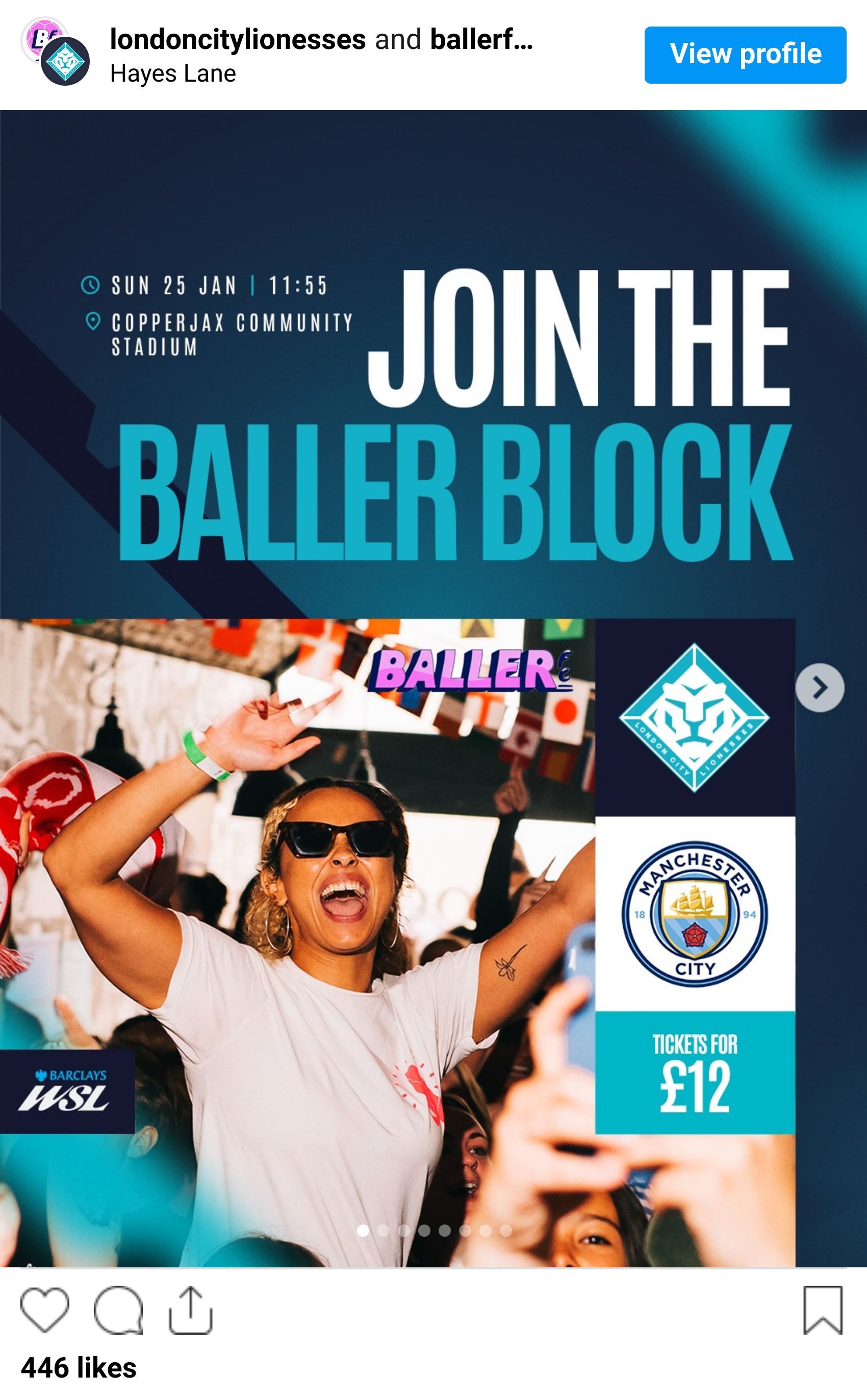
For newer fans, particularly the young female demographic where we’re seeing huge growth, we’ve been experimenting with different things. We had Baller FC [a women’s football fan collective] at a recent game, where they did an amazing match-day activation. We’ve also introduced other elements around the stadium, like a DJ booth with flashing lights, and a photo booth at our recent game where people could get Polaroid-style pictures.
We’re trying to maintain as much of our original offer as possible while also attracting new crowds and new audiences. We want to grow the fan base while still catering for our original fans. It’s about striking that balance and staying in contact with them. We receive a lot of feedback from our games, some good and some bad, and we’re always acting on that and looking at what we can do better.
As attendances and player profiles continue to grow, how do you balance keeping players accessible to fans while also protecting their time, wellbeing and safety?
A benefit of supporting London City Lionesses and coming to our games is that it’s still played in a small stadium, so you feel very close to the action.
But those opportunities to get up close to the players after the full-time whistle are becoming more limited as the profile of the game grows. It’s not just about whether players can see every fan after the game; it’s also about player safety.
Part of my role is to sprint onto the pitch at the final whistle and put down mini footballs on the sidelines. The players then sign the ball and hand it to someone in the crowd. This was born out of that question of how we can still create a special experience for people that feels accessible. Not everyone is going to get a mini football, but everyone has a chance to if you’re there, waving your hands around and trying to catch it.
It’s our way of striking a balance between keeping players safe and making sure they’re not standing around for hours post-game signing autographs – which I’m sure they’d love to do, but it’s just not feasible alongside other commitments – while still making sure fans feel they have that opportunity to get up close to the players. It’s been a really successful initiative.
How do digital platforms and social media support your wider fan engagement strategy?
Our social media team do a fantastic job building our following, but players and fan representation play such a huge role on our digital platforms. It’s so much more engaging when, rather than a text post or a graphic, you’ve got a player in a video speaking directly to you. It feels like a personal message – come to the game, come and support us.
Players have big followings themselves, so they’re a huge pull for people to come to our games and support London City. At the same time, we’re also looking to represent fans more on our social channels, so people can see someone who looks like them, or someone having a great time, and think: ‘I want to do that too.’ That helps us appeal not just to our existing fan base, but to new people as well.
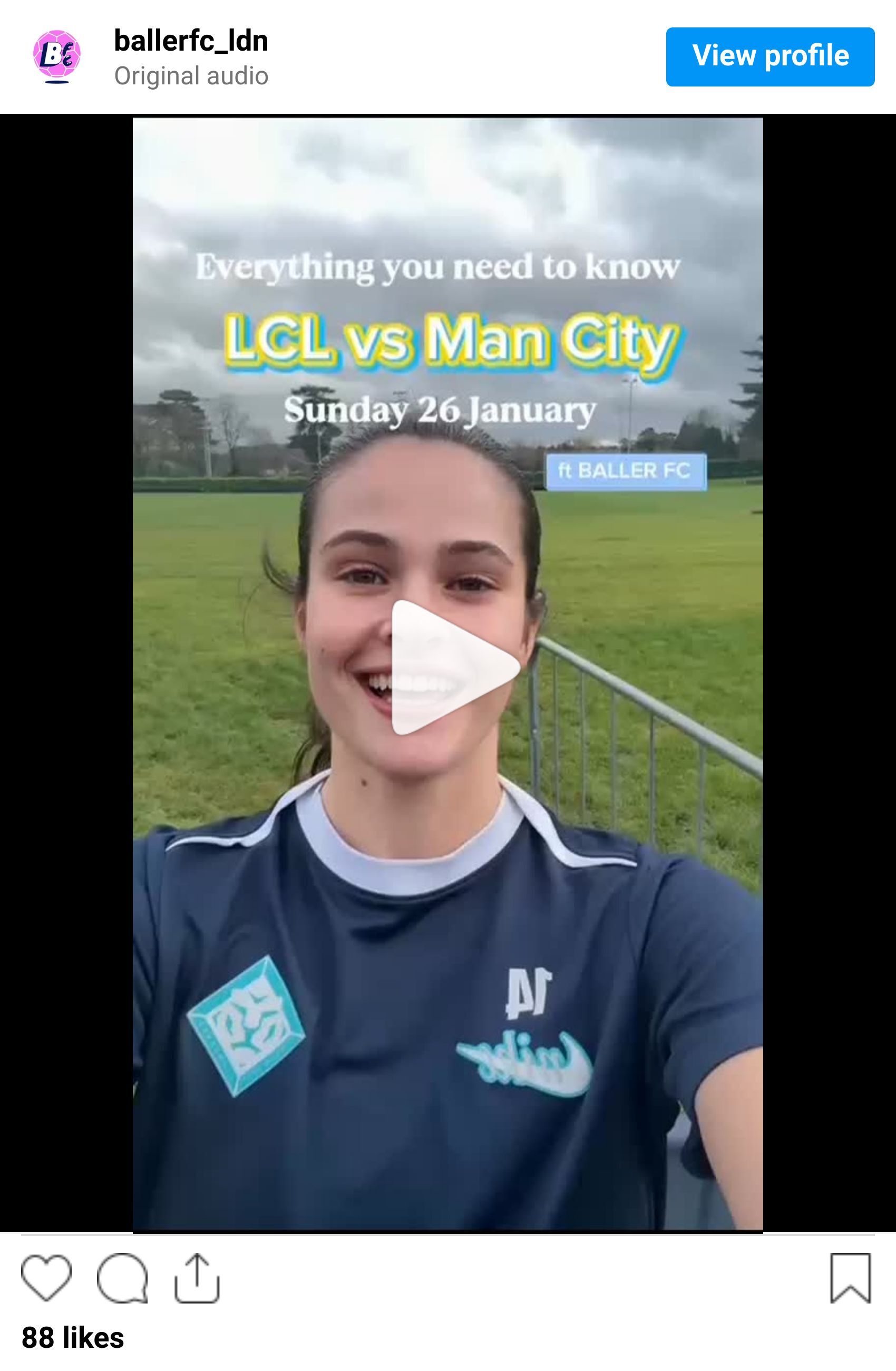
We did a really nice piece of content recently with one of our players, Freya Godfrey, a member of Baller FC and two members of our supporters’ club. They did a collaborative video promoting the game and encouraging people to come down and have a good time. It was really well received, probably because it felt nicely rounded, with representation from a player, supporters and an organisation bringing energy and vibes. We got a lot of positive feedback on how community-focused it felt, which was great.
Even though I don’t work directly on our social media channels, it plays a huge part in the success of the initiatives I put on and in growing the fan base.
When you look at the growth of womens’s sport right now, what do you see as the biggest opportunity and the biggest challenge?
As women’s sport continues to grow, it will hopefully become more mainstream in the best possible way – not that it loses its excitement, but that it simply becomes normal. Young people will grow up seeing women’s sport everywhere and female athletes won’t feel like an exception.
That, to me, is the most exciting opportunity – the ability to empower young people and give them visible, credible role models. Using women’s sport as a vehicle for that feels really powerful. For us as a club, it’s also an exciting time because we’re a rapidly growing organisation and we’re rising alongside that wider journey in women’s sport.
The biggest challenge is probably the flip side of that opportunity. I live very much in a women’s football bubble – my work, my interests, my social media algorithm – so while I see all the positive momentum, I also see the negativity. Breaking down stereotypes, outdated opinions and, in some cases, a reluctance to even give women’s sport a chance is still a challenge.
There’s still a level of ignorance around women’s sport. Some people form opinions without ever engaging with it properly, because they’ve been influenced by what they see online or by attitudes within their own circles. Of course, not everyone is going to like it, and that’s absolutely fine, but the challenge is making sure people have the opportunity to watch it, experience it and decide for themselves.
Those two things really do go hand in hand. As women’s sport continues to grow and becomes more visible and accepted, that resistance should gradually diminish. So, while it’s a challenge now, it’s also something that feels like it’s moving in the right direction.
